Where the Ceiling Is Cheap
And why upside is worth almost nothing in round two and quite a lot in round fourteen.

Every year we try to identify players who will outperform their projections. Oftentimes these are the guys that end up winning leagues - anyone can tell you that an elite superstar is going to be someone you want to draft in the early rounds, but finding middle of the lineup players that have a chance to significantly outperform their projections can take your team to the next level.
In this article we’ll take a look at some players that have a chance (1 in 10 seasons) to hit a real home run.
The Takeaway, Upfront
Star players are always going to go early in drafts, so there isn’t much value in worrying about their ceiling projections (but we’ll still touch on them). The real value of projection ranges is later in drafts when you can take a swing on an unproven player with upside that your competition might not see. Three players I’ll be looking to grab are:
Ilya Protas (WSH) - Projected for 25 points (3 floor / 58 ceiling)
Porter Martone (PHI) - Projected for 48 points (14 floor / 94 ceiling)
Anton Frondell (CHI) - Projected for 45 points (15 floor / 85 ceiling)
The Players
Let’s start by taking a look at the top-10 “upside” players that Ocelot has projected:
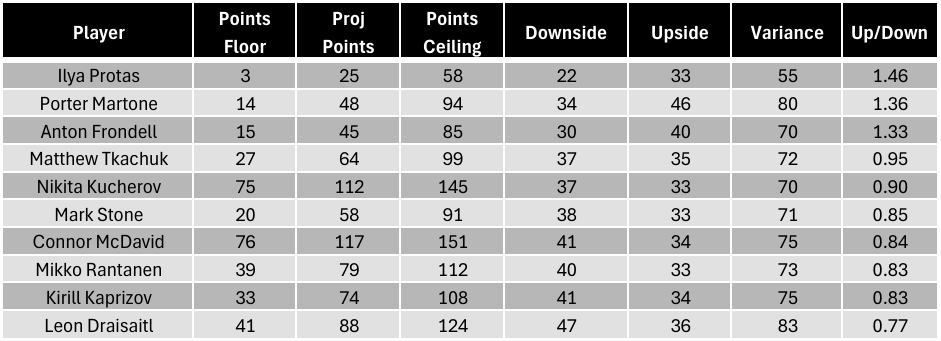
We’re going to focus on total points for this article. As a reminder, the “low” projection is the P10 outcome (10th percentile), the projection is the mean of the expected distribution, and the “high” projection is the P90 (90th percentile, 1 in 10 seasons).
Looking at the table above there are three main player types represented:
Rookies with less than a season of NHL history
Stars who have had recent seasons derailed by injuries
Stars with the highest per-game stat rates where actual games played will drastically move their total points
Protas’ projection looks a bit strange, so a quick note on that - his range is largely games played driven. Because of his thin history the floor case has him at 8.8 GP, his projection at 39.6 GP, and his ceiling at 82.6 GP.
Defining the “Ceiling”
The ceiling projection is the P90 outcome. That means that we should expect the player to hit it one season in ten - it is a realistic (albeit uncommon) outcome, not some dream scenario.
When it comes to drafting I think the ceiling is an important thing to consider, but its only really interesting relative to what you pay for a player. In the early (and probably even mid) rounds it is almost always best to draft based on the projection, using the ceiling as a kind of tie breaker. As the draft moves into the later rounds (where players are likely to end up as drop candidates anyways) I’ll put more weight on the ceiling as the value of finding a diamond in the rough at this point outweighs the risk of a wasted pick.
Two Groups, Opposite Shapes
Looking back to the top-10 upside players there are three rookies and seven veterans. If we look at each group’s upside relative to their downside (projection minus floor) an interesting trend develops:
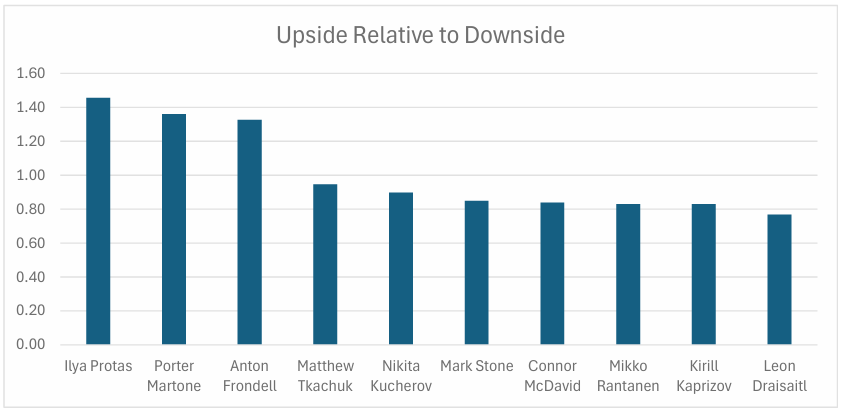
The right tail (the upside) for all the rookies is larger than the left tail (the downside), while for all the veterans the situation is reversed. This is explained by games played, not scoring rates. In the model, young players with small games played samples receive durability profiles with a long right tail because if they stick in the lineup they end up playing a lot more games than the projection assumes. Veterans get the opposite - their downside is an injury shortened season.
Three Flavours of Upside
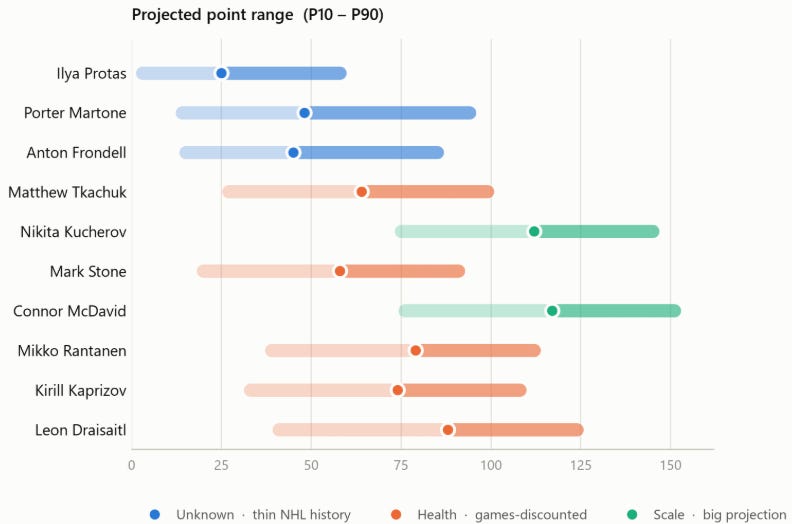
Let’s look at the projections in a bit of a different way - by where each player’s upside actually comes from. The chart below shows each player’s projected points range, colour coded for which bucket they fall in (blue for thin NHL history, orange for health, green for scale).
Scale Upside
McDavid and Kucherov are on the top-10 list because they are expected to put up big numbers, but there is some uncertainty around talent drift and expected games played. Both of these players have been relatively healthy over the years, but they’ve also had some absences. At their expected scoring rates an extra five games played is worth a lot.
Health Upside
Tkachuk and Stone both had significant injuries in the 2025-26 season that caused them to miss significant time. Draisaitl, Rantanen, and Kaprizov also had injuries that kept them out of the lineup for extended stretches of recent seasons. This in turn caused their projected games played to take a dip (for example, 65.9 for Tkachuk and 62.6 for Stone). In these cases the ceiling value is really a “he plays a mostly full season” value. Put another way their ceiling is a health bet, not a talent bet.
Unknown Upside
Young players don’t give us a lot of history on which to build a projection. Martone, Frondell, and Protas have 153, 212, and 64 minutes of NHL experience, respectively. As a result they have wide projection bands - Protas’ 3 point floor and 58 point ceiling illustrate this to the extreme. These wide ranges present an opportunity for late-round steals… choosing the right young player late can do wonders for your team (how many leagues had Schaefer go undrafted last season?), while the downside is limited to a wasted pick that can be easily replaced by a waiver claim.
So, What Can You Actually Do With This?
Knowing a player’s upside doesn’t really do too much for you at the top of the draft. The McDavids and Rantanens and Draisaitls of the world are always going to go early so there isn’t any edge to be gained there. Even players like Matthew Tkachuk and Mark Stone (rightly) go early because people will believe (or hope) that this is the year they avoid injury.
The real edge lies with skaters further down the lineup poised for a potential bounce back or breakout season, and with the unproven rookies who could take the league by storm. Martone is likely to be a hot commodity given his playoff performance, but chances are Frondell or Protas will be around in the later rounds.
A Few Caveats
It’s all fine and dandy to think about a player’s ceiling case, but there are some things to keep in mind:
The ceiling is a 1-in-10 outcome. Not all (not even most) players will hit their ceiling projection.
Rookie ceilings assume a player is going to get NHL roster time. They don’t do you any good if they end up in the AHL partway through the season.
Injuries bite both ways. A player avoiding injury is more likely to get closer to his ceiling, but a typically durable player getting hurt will move him toward his floor.
Wrapping Up
In this article we looked at a few players that have a chance of significantly outperforming their projections. For guys at the top of the draft this information isn’t terribly helpful, but it can help you find some later round sleepers like Protas and Frondell.
Stay tuned throughout the summer - I’ll be sharing more sleeper picks as we get closer to draft season!